What is The Meaning Behind Animal Sacrifices
Understand the meaning behind the sacrifices God had Israel play as skits. Demonstrating the rules for justification for life. How the different animals used played a part in the demonstration, showing how it was that Jesus' life was able to Redeem the whole world of mankind born in Adam.
James Schucker
Understanding The Meaning Behind Animal Sacrifices Offered for Sin and Especially those done on the Day of Atonement
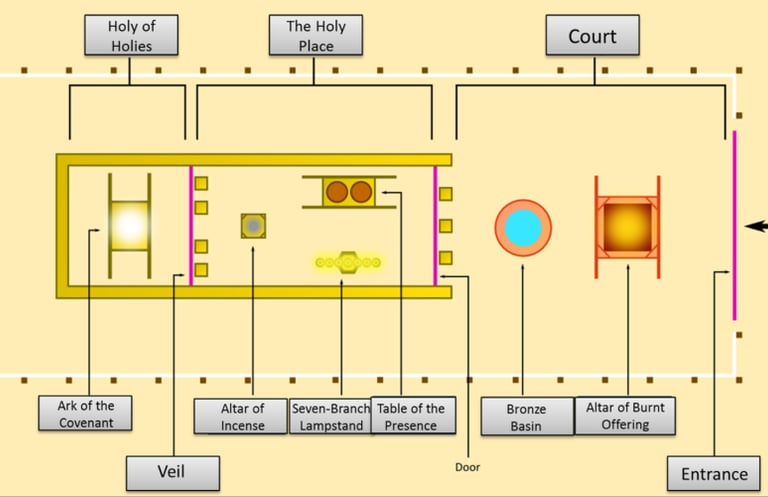
What lesson did the Lord intend Israel to learn through the sacrifices described in scripture? This question puzzled me for many years, and only since 2024 have I felt that I understand it more clearly. One aspect I struggled with was why the person offering the sacrifice had to own the animal. If the animal was meant to represent Jesus, how could Jesus be pictured as belonging to the one making the offering? Weren't we the ones “bought with a price?” 1Corinthians 6:19-20, Leviticus 1:2-3 See also: 2 Samuel 24:20-24 and Deuteronomy 12:6.
What makes Atonement
What I have learned on this account is that under the law there is a distinction made between the flesh of an animal and its life. Scripture states in Leviticus 17:11: "For the life of the flesh is in the blood, and I have given it to you to make atonement for your souls upon the altar; for it is the blood that makes atonement for the soul." Israel under the law was then permitted to consume the flesh of an animal for physical nourishment but not its blood, which is stated to represent its life. Conversely, when an individual uses an animal to make a sin offering sacrifice under the law, the sacrificer is portrayed as receiving the animal's life but then they are not permitted to eat its flesh. That animal's flesh was to be consumed by the priest doing the offering as stated in Leviticus 10:17-18 “it was given to you [the priesthood] to take away the guilt of the congregation by making atonement for them before the LORD.”
In the process of making these sin-offering sacrifices as stated in Leviticus 4, if the one making the sacrifice incurs guilt “he is to lay his hand on the head of the appropriate animal [the appropriate animal depends upon the individuals status in the community] being offered, so that it can be accepted on his behalf to make atonement for him.” The transfer of one's guilt is then understood to be achieved by the laying of the offeror's hand upon the head of the animal being offered. The animal being offered is then considered equivalent to the owner of the animal saying, this animal represents my flesh, and I am placing the sin of my flesh upon the altar as a sacrifice, and at the same time I am promising that I will actively put to death that part of my actual flesh that caused me to do what I did. This is well stated by the apostle Paul in Galatians 5:24-25 “Those who belong to Christ Jesus have crucified the flesh with its (sinful) passions and desires. 25Since we live by the Spirit, let us walk in step with the Spirit.” For the Christian this same thing is pictured by baptism. →As we are lowered under the water, we are putting the life we inherited from Adam to death. As we are raised out of the water it pictures receiving back spiritual life - the blood of the animal - and help from our risen Lord Jesus. Also notice Colossians 3:3 "For you died, and your life is now hidden with Christ in God. 4When Christ, who is your life, appears, then you also will appear with Him in glory."
Continuing with the law, the blood of the animal represents the life received from the sacrificed animal. The one doing the sacrifice is spiritually saying I am putting to death my flesh, and it is now the blood-life of the animal which I am slaying that is now going to live within me. This is stated by Paul giving to us the antitype in 2 Corinthians 4:10-12 “We always carry around in our body the death of Jesus, so that the life of Jesus may also be revealed in our body. 11For we who are alive are always delivered to death for Jesus’ sake, so that the life of Jesus may also be revealed in our mortal body. 12So then, death is at work in us, but life is at work in you.” Which is another way of Paul saying I am sacrificing my life and energy which I have received from Jesus on behalf of the Corinthians. Again the equivalent act for a Christian is shown in Baptism. Another one along this same line is found in Galatians 2:20 “I have been crucified with Christ, and I no longer live, but Christ lives in me. The life I live in the body, I live by faith in the Son of God, who loved me and gave Himself up for me.”
The passages in Galatians and Corinthians help explain the meaning of the animals sacrificed under Jewish law. They show what Israel was meant to understand through those sacrifices. The requirement for an unblemished animal pointed forward to the Messiah, whose flesh would be perfect and who would be “holy, harmless, undefiled, separate from sinners” as stated in Heb. 7:26. In other words, he would be the one who could truly keep the law. They were also meant to understand that the life of the animal represented the Messiah’s life, given by God, and was meant to picture the life you are now called to live. Therefore, strive to live as Jesus lived. And just as that animal’s life was sacrificed on your behalf, you should likewise offer your time and abilities for others, becoming a sin offering yourself, as stated in Romans 12:1.
Can Animals Lives Actually Atone for Sin?
The limitation of those animal sacrifices is that they contained no eternal life. They pointed only to the reality of what Jesus would do for us. Animals die just as we do. As Ecclesiastes 3:19 says, “For the fate of men and beasts is the same: as one dies, so dies the other; they all have the same breath. Man has no advantage over the animals. 20All go to one place; all come from dust, and all return to dust.” This is illustrated when God provided the animal He killed to cover Adam’s sin after which Adam was driven from Eden and lost access to the tree of life. Although Adam was, in a legal sense, “atoned” for by that animal’s life, he still died because he could no longer eat from the tree of life, as stated in Genesis 3:22-24. “And Jehovah God said, Behold, the man has become as one of us, knowing good and evil; and now, lest he reach out his hand and take also from the tree of life, and eat, and live forever... therefore Jehovah God sent him out from the garden of Eden to till the ground.” There is nothing wrong with knowing good and evil but how to teach man that knowledge is what the whole plan of God is about. The issue, from God’s perspective, is how long a person must endure sin and its consequences to learn that lesson. The Lord sought to limit man's pain and suffering, so He barred access to the tree of life and allowed death to bring that experience to an end. At the same time, He began to reveal what would be required to address the consequences of disobedience. Another life would be needed to cover that sin, because the life Adam was now lost. Spiritually speaking the blood of the animal the Lord slew was running through the veins of Adam and Eve.
The second time God provided an animal to be used to picture what Christ does for us is when Isaac asked Abraham, “where is the lamb for the burnt offering?” Found in Genesis 22:7-8 Abraham said, “God will provide for himself the lamb for a burnt offering, my son”. Again, the problem is that the animals used to do the redeeming work had no actual everlasting life in them. This was just a skit being performed looking forward to the reality of Jesus. This problem is well stated and solved by what is stated in Romans 8:3 “For what the law was powerless to do in that it was weakened by the flesh, God provided by sending His own Son in the likeness of sinful flesh, as an offering for sin.” Also stated in: John 6:51 “This bread represents my flesh, which I will give for the life of the world.” A person's sacrifice in seeking forgiveness and atonement cannot be a sacrifice of just time and effort as is stated by the Apostle Paul in Hebrews 9:22 “without the shedding of blood there is no forgiveness.”
We need to notice the details that occur in the scriptures if we really want to understand. In the account of Abraham and Isaac, they both mentioned that God would provide a lamb, yet we note that it was a ram that was ultimately offered. The difference between the two is that a lamb is a young sheep, typically a year old or less, while a ram is an adult male sheep. We should ask ourselves why it is that Jesus is pictured as different kinds of animals. He is pictured in scripture as a lamb, a ram, a goat, a bullock, a serpent and a lion… When the Lord slew the animal that was used to cover Adam and Eve, we are not told what kind of animal was used because that was not the point at that time. Now that we know the difference between a lamb and a ram, we ask then, when was the lamb slain? The answer spiritually is “from before the foundation of the world” as stated in Revelation 13:8 & Ephesians 1:4. That was when Jesus was still a lamb and was still so at his baptism according to John 1:29. However by the time he died on the cross, he was a ram! Meaning, by that time he had “learned obedience by the things he suffered. 9And having been made perfect, He became the source of eternal salvation to all who obey Him” Heb 5:8-9.
Note: it is his unjustified suffering that he endured that made him a “Sin Bearer” hence becoming a "sin offering". Galatians 3:13 “Christ redeemed us from the curse of the law by becoming a curse for us. For it is written: “Cursed is everyone who is hung on a tree.” Jesus kept the letter of the law perfectly, but in keeping it they hung him for it, and it was then that he broke it. Thus, it is that "the Letter kills but the spirit gives life". 2 Corinthians 3:6
After realizing and understanding the above thoughts I began focusing my attention on trying to understand the foundational Law's of sin offering sacrifices specified in Leviticus the 4th chapter and how those laws were to be fundamentally applied to Leviticus 16 which deal with the sin offerings, done yearly on the Atonement Day. Four types of animal sacrifices are mentioned and are tied to the social status of those doing the sacrificing.
"If a priest sins, bringing guilt on the people", a bullock is required to be offered to offset the effect of that sin… Lev 4:3 (transferring his guilt to the bullock)
"If the whole congregation sins and incurs guilt," again a bullock is required, and the elders of the congregation are required to put their hands upon the head of that bullock and it is then that it is slaughtered (transferring their communal guilt to the bullock) … Lev 4:13
"When a leader (an exalted one, a king, or prince) sins unintentionally, he incurs guilt…" he is required to bring an unblemished male goat as his offering… Lev 4:22 Note at the time the Lord was giving Israel these laws Israel had no king or prince. More about this later.
"If one of the common people sins unintentionally, he incurs guilt." He is required to bring an unblemished female goat or lamb as his offering for that sin…" Lev 4:27 Note: this reminds us of the parable of the Sheep and Goats of Matthew 25:31-46
Laying on of Hands Heb 6:2
The Apostle Paul says: “Therefore let us leave the elementary teachings about Christ and go on to maturity, not laying again the foundation of repentance from dead works, and of faith in God, 2instruction about baptisms, the laying on of hands, the resurrection of the dead, and eternal judgment. 3And this we will do, if God permits.” Bible students rarely discuss the laying on of hands because it mainly pertains to sacrifices depicted in the law, which Christians today seldom address. Nevertheless, Paul characterizes it as a fundamental concept that we need to understand especially if we want to understand the meaning behind animal sacrifices.
It has been observed that in each instance, the individual making an offering for their sin is required to possess ownership of the animal. This requirement is found in Leviticus 1:2-3 and states that a person bringing an offering must offer it from their own herd or flock, indicating ownership. Some translations are better than others on the ownership. But 2 Samuel 24:20-24 records David insisting on purchasing the land and oxen for his sacrifice, saying, "I will not offer burnt offerings to the Lord my God that cost me nothing." I believe they were required to own it because what they were about to do with the animal is spiritually what we are to do with our own flesh. The person then lays his hand upon its head and slays it, spiritually saying, ‘on the one hand I am transferring the guilt of my sin to the animal (representing my flesh) and with the other hand I am putting my flesh to death. This spiritually signifies that the animal's death serves to release from the death penalty of the person, who had committed the transgression, so that he might continue to live. It is noteworthy that the individual receiving atonement through the sacrifice consistently stands beside their own animal, which they must slay to provide the redemption price of life. It should not be too difficult to see then that this is what is happening as a demonstration with the two goats on the day of atonement. The one goat is meant to show the redemption-atonement of the other. It is in effect picturing a ransom, where one dies to set free the other. This is what Paul was pointing out in Romans 5:11-21 of how Jesus died a corresponding price for Adam. Two goats were used as stand ins because Adam had already died, and Jesus had not yet come. Rom.5:18 "So then, just as one trespass brought condemnation for all men, so also one act of righteousness brought justification and life for all men. 19For just as through the disobedience of the one man the many were made sinners, so also through the obedience of the one man the many will be made righteous. it is obvious the Apostle Paul is referring to the two goats of the sin offering.
The animal sacrifices appear to illustrate how a person may be “set free” from the guilt and death penalty of sin, as Paul also describes in Romans 6:7, 18, 22, and Romans 8:21. In many passages where Paul speaks of being “set free,” he seems to draw on the image of the scapegoat, which was released into the wilderness because another goat had died in its place. Ezekiel 18:20 states, “The soul that sins, it shall die.” The principle, then, appears to be that the sacrificed animal dies on behalf of the sinner, allowing the guilty person to be “set free” from sin and continue living. In this sense, the sacrifice redeems or ransoms the sinner. Ultimately, the life of the sacrificed animal points to the sacrifice that Jesus our Messiah and Redeemer made on our behalf. Explaining this clearly can be difficult, especially because many people already hold strong assumptions about the meaning of Israel’s sacrifices. The clearest explanations I have found come from the apostle Paul, whose familiarity with these sacrifices gave him insight that many contemporary Christians lack and helps explain his frequent use of sacrificial language.
With this in mind, let us return to Adam’s experience. In Genesis 2:16–17, God told him, “You may eat freely from every tree of the garden, but you must not eat from the tree of the knowledge of good and evil; for in the day that you eat of it, you will surely die.” Adam and Eve disobeyed God by eating from the forbidden tree, and their sin ultimately led to death. Yet an important question remains: why did Adam live more than 900 years and have descendants before dying? Before allowing Adam and Eve to continue living, the Lord slew an animal for them, took its skin, and clothed them. Though they had become sinners, this act began to show what was needed to cover their sin—and that God Himself would provide it. Isaiah expresses this spiritual reality in Isaiah 61:10: “I will rejoice greatly in the LORD; my soul will exult in my God; for He has clothed me with garments of salvation and wrapped me in a robe of righteousness…” This imagery points to Christ, who clothes us with His own spiritual covering. In this sense, we are antitypically covered by Jesus’ “skin,” described in Scripture as “a robe of righteousness.” Paul states the same truth in Romans 13:14: “clothe yourselves with the Lord Jesus Christ and make no provision for the desires of the flesh.”
The price Adam and Eve paid for gaining the knowledge of good and evil was the loss of their right to continue living in the paradise God had prepared for them. Instead, they—and their descendants—were condemned to live under the burden of hard labor in a wilderness condition. In that sense, we all share the same sentence and are all learning the knowledge of good and evil together. It was a terrible price to pay. To help us understand how His salvation and reconciliation work, the Lord gave Israel sacrificial “skits” using live animals. These sacrifices illustrated what God ultimately sees as necessary for humanity’s redemption from sin. Paul expresses this in Romans 3:25–26: “God presented Jesus as the atoning/propitiation sacrifice through faith in His blood… 26He did this to demonstrate His righteousness at the present time, so as to be just and to justify the one who has faith in Jesus.” This appears to be another reference to the Day of Atonement sacrifices. However, because many translations use propitiation rather than atoning sacrifice, readers may miss Paul’s connection to those sacrifices. Paul develops this idea further in Romans 5, where he points back to the Day of Atonement ritual described in Leviticus 16. The clue is his statement that “we have now received the Atonement” in Romans 5:11 KJV. He then explains how the two goats of the Day of Atonement correspond to the flesh of Adam and Jesus. Yet if a reader is unfamiliar with that ritual—or if translations obscure the wording by using terms such as propitiation or reconciliation instead of atonement—the connection can easily be missed. Paul continues: “12Therefore, just as sin entered the world through one man, and death through sin, so also death was passed on to all men, because all sinned… 18So then, just as one trespass brought condemnation for all men, so also one act of righteousness brought justification and life for all men. 19For just as through the disobedience of the one man the many were made sinners, so also through the obedience of the one man the same many shall be made righteous… Paul could hardly state the correspondence more plainly.
The Atonement Day Sacrifices
The Day of Atonement sacrifices were a unique, once-a-year sin offering with special meaning and instructions. They followed the rules for the sin-offering sacrifices in Leviticus 4, but added further details. These sacrifices appear to illustrate how Jesus, through His one sacrifice, could redeem both Himself and His body, the Church [pictured by the bull], as well as the whole world of mankind [pictured by the scapegoat]. They also show that, when the sacrifice is complete, the Lord will appear—not merely in the “cloud above the mercy seat” of Leviticus 16:2, but in the cloud described in Revelation 1:7: “Behold, He is coming with the clouds, and every eye will see Him—even those who pierced Him…” Hebrews 7:27 emphasizes another distinction: “Unlike the other high priests, He does not need to offer daily sacrifices, first for His own sins and then for the sins of the people; He sacrificed for sin once for all time when He offered up Himself.”
The same pattern appears in Hebrews 9:7: “But only the high priest entered the second room, and then only once a year →{Atonement Day, Leviticus 16:34}←and never without blood, which he offered for himself →{the bull, Leviticus 16:6, 11}← and for the sins of the people →{the goat, Leviticus 16:15, 24}← committed in ignorance.” Paul is referring to Leviticus 16:6, where “Aaron is to present the bull for his sin offering and make atonement for himself [Jesus and the Church] and his household [the Great Company].” He also points to Leviticus 16:15: “Aaron shall then slaughter the goat for the sin offering for the people and bring its blood behind the veil, and with its blood he must do as he did with the bull’s blood…”
Next in the Day of Atonement arrangement, two unblemished goats of equal value are chosen to portray the ransom—the “one for one” principal Paul develops in Romans 5:11–21. One goat is sacrificed on behalf of the other, which is then “set free.” This follows the basic pattern of the sin offering: a life is given so that another may be released. Here, however, the picture is not a human being released through the death of an appropriate animal, but a goat released because another goat has died in its place.
This imagery recalls Adam and Eve. Before they were expelled from Eden into the uninhabited wilderness of the world, an animal was sacrificed to cover their sin. Likewise, the scapegoat, representing Adam, is “set free” and sent into an uninhabited wilderness. This pattern helps show that the scapegoat spiritually represents what happened to Adam after God provided the covering for sin in Genesis 3:21–24.
This acted picture symbolizes humanity’s transgressions being placed upon Adam’s flesh, after which Adam is released because of the life-rights Jesus purchased by keeping the Law and willingly giving His life for Adam and, through Adam, for the whole human race. This is what was “to be testified and effected in due time” in 1 Timothy 2:6. The scapegoat is released by the ransom price and power of the sacrificed goat. In this picture, Adam’s goat-flesh receives redemption through the death of Jesus’ goat-flesh, which He received from God and from Mary, the “seed of the woman” in Genesis 3:15.
Romans 5:11–21, especially verse 14, supports this parallel by stating that “Adam is a pattern of the one to come”—that is, Jesus. This creates another picture: when Jesus was put to sleep on the cross, His side was pierced, and blood and water came out, corresponding to Adam’s rib, from which God formed Eve. In this way, Jesus forms the second Eve. In Romans, Paul shows that the ransom is central to this part of the sin offering. Through Jesus’ sin offering, God will restore actual paradise, not merely return humanity to a guilt-free life in the wilderness. See Leviticus 16:21–22. It should also be noted that Eve is pictured as still within Adam, just as the second Eve is pictured as still within Jesus’ flesh at His death.
On the Day of Atonement, enacted as a living picture, Israel’s sins were forgiven and the people were restored to a guilt-free condition like Adam after he was cast out of Eden. Their guilt was symbolically placed on the head of the scapegoat, which represents Adam. Leviticus 16:20–22 says, “When Aaron has finished purifying the Most Holy Place, [with the blood of the bullock and goat] the Tent of Meeting, and the altar, he is to bring forward the live goat. 21Then he lays both hands on the head of the live goat and confesses over it all the iniquities and rebellious acts of Israel regarding all their sins. He is to put them on the goat’s head and send it away into the wilderness by the hand of a man appointed for the task. 22The goat will carry on itself all their iniquities into a solitary place, and the man will release it into the wilderness.” To be “set free” means to be released from human control or dominion. The goat is returned to the wild—the same kind of wilderness into which Adam was sent.
The difficulty is that, in other sin offerings, the guilt is placed on the animal that is slain. Here, however, at least some of the guilt appears to be placed on the live goat that is set free. Why is this? It seems intended to remind us of the Scripture that says we “fill up that which is behind of the afflictions of Christ.” This point will be addressed again later.
It is tempting to identify the scapegoat with Jesus when reading Isaiah 53:12, which says, “Yet He bore the sin of many.” However, the context points instead to the goat that was sacrificed, not the scapegoat: “Therefore, I will allot Him a portion with the great, and He will divide the spoils with the strong, because He has poured out His life unto death, and He was numbered with the transgressors. Yet He bore the sin of many and made intercession for the transgressors.” As with all sin offerings, we are to see the life of the sacrificed animal as being spiritually transferred to the one for whom it was offered. In this case, Jesus gave His life directly for Adam, who is eventually set free. Because we are born in Adam, we also are “set free” by faith in that ransom transaction for Adam’s race. This is accomplished through our adoption, as shown in Ephesians 1:5 and Galatians 4:5.
This still raises the question of how Jesus bore humanity’s sin and guilt. He did so quite literally by taking on flesh as the antitypical goat that was sacrificed. By becoming a descendant of Adam, living among us, and sharing in the condemnation placed upon Adam’s race, Jesus bore the ultimate consequence of Adam’s transgression—death. Yet He Himself did not sin, which gave Him the right to life under the Law, as stated in Leviticus 18:5: “Keep My statutes and My judgments, for the man who does these things will live by them. I am the LORD.” Likewise, 1 Peter 2:24 says, “He Himself bore our sins in His body on the tree, so that we might die to sin and live to righteousness. By His stripes you are healed.” In this way, Jesus took Adam’s stripes upon Himself as part of the punishment for Adam’s disobedience.
In most sin offerings, the person who committed the sin both provided and slew the animal used for redemption. There are three notable exceptions: first, God provided the animal that covered Adam; second, God provided the ram for Abraham and Isaac; and third, on the Day of Atonement, “Aaron shall take from the congregation of Israel two male goats for a sin offering.” Under the Law, the one being redeemed is consistently placed beside the animal that provides the redemption price. This creates an important picture on the Day of Atonement: two goats stand together, suggesting that the flesh of one represents the redemption of the other. Since Jesus died to redeem Adam, this connection should not be difficult to see. It is also stated in 1 Corinthians 15:21–22 and Romans 5:12–19. In this picture, the flesh of Jesus, who died, covers or redeems the flesh of Adam—the antitypical goat that was released into the wilderness, just as Adam was.
Multiple Reasons the two Goats Represent Adam & Jesus
(#1) In Leviticus 4:22–23, we read: “When a leader [prince] sins unintentionally and does what is prohibited by any of the commandments of the LORD his God, he incurs guilt. When he becomes aware of the sin he has committed, he must bring an unblemished male goat as his offering.” Yet when the Lord gave Israel these sacrificial “skits,” Israel had no prince. The kingship was withheld for ten generations because of Judah’s sin with Tamar, as reflected in Deuteronomy 23:2. Israel’s first true king, or prince, was David, who came ten generations after Judah. In this sense, the Lord had Israel use another goat as a placeholder for their future prince. More deeply, however, the world’s first true prince, Adam, had already died and was the actual prince in need of redemption, as Paul explains in Romans 5:11–21. For this reason, the Lord appears to have ensured that Israel had no human prince at the time He established the Day of Atonement sacrifices.
(#2) In Psalm 82:6–7, God says, “I have said, You are gods; and all of you are children of the Most High. 7But you shall all die like men and fall like one of the princes.” Jesus applies this passage in John 10:34, identifying Himself with those princes. The contrast, then, is between dying as a sinner like Adam, the first prince, or dying like Jesus, the second Prince, as a sin offering, as reflected in Romans 12:1. In this view, the two goats represent the world’s two princes—Adam and Jesus—with Jesus dying to redeem Adam. This, I believe, is Paul’s point in Romans 5:11–21, where he again connects the matter to the Day of Atonement sacrifices. The King James Version uses the word atonement, while most other translations use reconciliation. Even so, I am convinced that Paul was referring to the Day of Atonement sacrifices.
(#3) In Genesis 22:8, Abraham says, “God will provide for Himself the lamb for a burnt offering, my son.” God then provides a ram caught in the thicket, as recorded in Genesis 22:13. Abraham’s intended sacrifice of Isaac was replaced by the ram, a mature lamb. A similar pattern appears on the Day of Atonement: after the bullock and goat are slain, a ram is also offered for each. This seems intended to show the acceptability of the earlier bullock and goat sacrifices, making all four animals point to the Messiah. Just as Isaac represented Jesus, the ram offered after the goat on the Day of Atonement shows that the goat also represents Jesus, the actual and acceptable sacrifice. Likewise, God’s sacrifice of an animal to cover Adam and Eve symbolizes what Jesus does for Adam and, through Adam, for mankind. In this context, the two goats represent #1 Adam, the prince needing redemption, and #2 Jesus, the prince who provides the corresponding ransom price. This is one of the clearest pictures of ransom presented in the sacrifices.
(#4) In Leviticus 4, a priest must offer a bullock, while a prince must offer a goat. Since Paul presents Melchizedek as a type of Jesus, and Melchizedek is both king and priest (Hebrews 7:1), it follows that Jesus must be represented by both offerings: the bullock and the goat. This is exactly what the Day of Atonement sacrifices picture. This is part of what Paul meant when he said of Melchizedek, “We have much to say about this, but it is hard to explain, because you are dull of hearing” (Hebrews 5:11).
Leviticus 16:6 says, “Aaron [representing Jesus] is to present the bull [the bull of Leviticus 4:13, for the congregation] for his sin offering and make atonement for himself and his household” [the Church/congregation in the antitype]. Then Leviticus 16:15 adds, “Aaron [again representing Jesus] shall then slaughter the goat [Jesus’ own flesh] for the sin offering for the people” [all mankind in Adam]. A ram was offered after the bullock and another ram after the goat, assuring us that both the bullock and the goat ultimately point to Jesus.
Paul summarizes the meaning in Hebrews 9:23–28: “But now He has appeared once for all at the end of the ages to do away with sin by the sacrifice of Himself.” The Day of Atonement “skit” therefore gives a detailed picture of how Jesus’ one sacrifice redeems two classes of people: #1, the first-born class, shown by Aaron and his bullock, picturing Jesus dying first for the Church through the bullock of Leviticus 4:13, which is for the congregation rather than the bullock of Leviticus 4:3, since Jesus Himself had no sin; and #2, the after-born rest of mankind, shown by the two goats, picturing Jesus dying for Adam and thereby ransoming all mankind. This shows the equivalency required by a ransom—life for life—as reflected in Exodus 21:24: “eye for eye, tooth for tooth, hand for hand, foot for foot.”
(#5) Hebrews 13:11–13 says, “Although the high priest brings the blood of animals [the bullock and one male goat] into the Most Holy Place [only once each year on the Day of Atonement] as a sacrifice for sin, the bodies are burned outside the camp. 12 And so Jesus [represented by the bull and the goat for two different classes of people] also suffered outside the city gate, to sanctify the people by His own blood. 13 Therefore let us go to Him outside the camp, bearing the disgrace He bore.” Here Paul again appears to refer to both the bullock and the goat as pictures of what Jesus accomplished with his single sacrifice—not only for us the "Church Class" but also for “the people,” meaning the whole world of mankind. He also indicates that we are represented by those who carried the remains outside the camp, “bearing His reproach.” In this way, we share in what Paul describes as “filling up that which is behind of the afflictions of Christ” in Colossians 1:24.
(#6) Leviticus 4:27–28 says, “And if one of the common people sins unintentionally and does what is prohibited by any of the LORD’s commandments, he incurs guilt. When he becomes aware of the sin he has committed, he must bring an unblemished female goat as his offering for that sin.” By contrast, in the Day of Atonement sacrifices, all the animals are male; no female animals are used. This again suggests that those sacrifices point to distinct aspects of Christ Jesus. But why, then, were the common people instructed to bring female goats for their sin offerings?
As Adam’s offspring, humanity includes both male and female. When Jesus called us, we were called out from Adam and into relationship with Him. In that sense, we may be viewed as His female goats: goats once in the wilderness, now set free by the blood of Jesus, which was used to purchase Adam. This appears to be what Paul suggests in Ephesians 4:22–24: “put off your former way of life, your old self [born in Adam as a goat], which is being corrupted by its deceitful desires; to be renewed in the spirit of your minds; and to put on the new self [begotten in Christ as His bride, making us His female goats] created to be like God in true righteousness and holiness.”
Paul states the same transformation another way in Ephesians 5:8: “For you were once darkness, but now you are light in the Lord. Walk as children of light…”
(#7) Hebrews 9:7 says, “Only the high priest entered the second room, and then only once a year {the Day of Atonement, Leviticus 16:34}, and never without blood, which he offered for himself {the bullock, Leviticus 16:6, 11} and for the sins of the people {the goat, Leviticus 16:15, 24} committed in ignorance.” This appears to be one of the strongest statements because Paul directly connects both the bullock and the goat with Jesus’ sacrifice. A third animal, the ram—a mature male sheep—was also offered that day, and it points to Jesus at His death, confirming the acceptability of the preceding sacrifice. First came the bullock for the priest’s house, picturing the Church; then came the goat, picturing Adam and all his offspring, as Paul also explains in Romans 5:11–21.
This also helps clarify the parable of the sheep and goats and Paul’s teaching that we must be transformed (Romans 12:1–2). In Adam, we are born with goat-like tendencies. To become acceptable as an offering to the Lord and prepared for the work He has for us as His bride, we must be transformed from a goat-like nature into a sheep-like character. This may explain why, in Leviticus 4:31, the only offering described as producing “a pleasing aroma to the LORD” is the female goat offering, which was offered only by the common people.
We also see that, on the Day of Atonement, a ram (a mature male sheep) was offered after both the bullock and the male goat, showing the acceptability of each preceding sacrifice. Therefore, if we desire to be acceptable to Jesus, we must be transformed from goat-like personalities into sheep-like personalities and come of age. As Hebrews 5:14 says, “But strong meat belongs to those who are of full age, even those who by reason of use have their senses exercised to discern both good and evil.”
Laying on of Hands continued
When a person offered an animal sacrifice, one hand was placed on the animal’s head to symbolize the transfer of guilt, while the other hand was used to slay it, thereby taking its life in harmony with the Law. On the Day of Atonement, however, the high priest slew the goat. Since Jesus is represented by the high priest, this points to His own words in John 10:17–18: “I lay down My life in order to take it up again. No one takes it from Me, but I lay it down of My own accord. I have authority to lay it down and authority to take it up again.”
It is significant that the laying on of hands is specifically stated for the scapegoat in the Day of Atonement sacrifices. Although the same act is not explicitly mentioned for the slain goat, it is implied by the general law of sin offerings. In every other case, the animal that dies receives the guilt. Here, however, at least some of the guilt appears to be placed on the goat that is set free. This mirrors what Adam did when he blamed Eve in Genesis 3:12. Paul also says in 1 Timothy 2:13–14, “For Adam was formed first, and then Eve. And it was not Adam who was deceived, but the woman who was deceived fell into transgression.” Thus, as the second Eve, the Church bears the deceived part of the blame.
The Day of Atonement sacrifices illustrate what Jesus does with the life He earned by fulfilling the Law—“the life is in the blood” (Leviticus 17:11). He first uses that life to redeem the Church, described as His household in Leviticus 16:11. Second, He uses it to redeem the world, described as the people in Leviticus 16:15. Paul expresses these two aspects of salvation in 1 Timothy 4:10: “who is the Savior of all men, especially of those who believe.” This indicates a special salvation for believers now, who become the firstborn class and will ultimately help lead the rest of mankind through the general resurrection of judgment toward life.
The high priest then lays both hands on the head of the live goat and, after confessing all the sins of the people over it, sets it free. As noted earlier, the left hand pictures the transfer of guilt. In this case, however, the right hand is used to liberate rather than terminate; the other goat was the one that was terminated. This is well expressed in Hebrews 12:24, which speaks of “Jesus the mediator of a new covenant, and to the sprinkling of blood, speaking better things than the blood of Abel.”
The life force of Jesus may then be viewed spiritually as living within the scapegoat’s flesh. Adam’s flesh, having been redeemed and spiritually set free, is sent into the wilderness, just as Adam and Eve were sent into the wilderness after an animal had been sacrificed on their behalf. This principle applies to all sin offerings, except that here a goat is set free instead of a human, as is customary in the other sin offerings.
But why does the priest confess Israel’s sins over the live goat before sending it away? Because more than Adam and Jesus are pictured here; Eve is also involved. Paul says in Romans 5:14 that “Adam is a pattern of the One to come.” When God confronted Adam, Adam placed the blame on Eve (Genesis 3:12). In the same way, the Church—called while still represented as being in Adam—is called to share in the remaining afflictions. Thus, as the second Eve, the Church bears “that which remains of the afflictions of Christ” (Colossians 1:24). The released goat therefore pictures Adam, with Eve still represented within Adam’s rib.
Just as Christ has many members, Adam also had many descendants, and we are all part of Adam’s offspring. We enter Christ by accepting Jesus’ call to become part of His bride. Part of that calling is bearing some of the consequences of the first Eve’s sin. This was illustrated when the Church was persecuted to death as scapegoats during what Revelation calls the Church’s wilderness condition (Revelation 12:14), which lasted 1,260 years, from 539 to 1799.
As noted earlier, we may die either like Adam, as sinners, or like Jesus, as part of a sin offering (Psalm 82:6–7). The goat sent into the wilderness represents the Church’s part in the sin offering. When we accept God’s call, He adopts us and transforms us into the body of Christ as an offering for sin. In this way, we are being trained to become the second Eve. This helps explain why, in Leviticus 4:27–35, the people’s offerings are only female goats or lambs.
Jesus speaks of this scapegoat experience in Matthew 5:11–12: “Blessed are you when people insult you, persecute you, and falsely say all kinds of evil against you because of Me. Rejoice and be glad, because great is your reward in heaven, for in the same way they persecuted the prophets before you.”
This helps explain why the female goats offered for sin by the “common people” appear in Leviticus 4:27–35. Paul expresses this same idea in Romans 5:17: “For if, by the trespass of the one man, death reigned through that one man, how much more will those [goats] who receive the abundance of grace and of the gift of righteousness shall reign in life through the one man, Jesus Christ”—as His bride.
This brings us to another important point in Leviticus 4. Why, when the common people sin, are they required to bring either a goat or a lamb—and why must it be a female goat or lamb? The two offerings are nearly identical, except that the offering of the goat is described as producing a pleasing aroma, or sweet savor. This phrase appears only once in the chapter and only in connection with the female goat offering. I believe the explanation is found in Luke 15:4–7: “Rejoice with me, for I have found my lost sheep! 7 I tell you that in the same way there will be more joy in heaven [pleasing aroma] over one sinner who repents than over ninety-nine righteous ones who do not need to repent.” When a female lamb is used, it may picture one who has already recognized sin and consecrated himself, representing those who “do not need to repent.”
This also sheds light on the parable of the sheep and goats. We are all born in Adam as goats, as Psalm 51:5 says: “I was shaped in iniquity; and in sin did my mother conceive me.” But when Jesus finds us, and we repent and dedicate our lives to Him. This is also stated in 2 Corinthians 2:14-17, “Now thanks be unto God, which always causes us to triumph in Christ, and makes manifest the savor of his knowledge by us in every place. 15For we are unto God a sweet savor of Christ. We should begin to become sheep-like in character. Some make greater progress than others, which helps explain the distinction between the Church and the Great Company in Revelation 7. Through the help of our Lord Jesus and His bride, the Church, we are being changed from goat-like to sheep-like. Which is a Sweet Savor/Pleasing Aroma unto the Lord.
The common people’s sacrifice had to be female, showing the Church’s positive role in the conversion and restoration of sinners. The Church participates in the sin offering during the antitypical Day of Atonement—the Gospel Age. By consecrating ourselves, we join Christ and become part of His sacrifice, entering the priesthood and the family of Christ as His bride. In this picture, we are represented by female goats who bear the blame Adam placed on Eve.
Why Sheep and Goats Matt 25:31
In the end, the Lord separates people as sheep and goats. Sheep are generally gentle, social, and willing to follow, while goats are more independent, curious, and inclined to wander or escape. Goats can be stubborn and troublesome, often getting into places they should not be. We are all born in Adam - goat like. But if we desire to live, we must all change to become more sheep-like.
Along these lines, Adam’s flesh may still be understood as living within our flesh, even as we strive to keep our bodies on the altar of sacrifice (Romans 12:1) and refuse to satisfy its desires (Romans 13:14). Therefore, when we sin unintentionally or act foolishly against our better judgment, we may say, “It is Adam’s life still active in our flesh that led us to do it.” Paul explains this in Romans 7:15–17: “I do not understand what I do. For what I want to do, I do not do. But what I hate, that I do… and in that case, it is no longer I that do it, but sin [of Adam] still living in me that does it.”
On the Day of Atonement, the sin of Adam’s flesh is spiritually pictured as being removed and placed upon Jesus. Paul expresses this in 2 Corinthians 5:19–21: “God was reconciling/Atoning the world to Himself in Christ, not counting men’s trespasses against them… Be reconciled/Atoned to God… God made Him who knew no sin to be sin on our behalf, so that in Him we might become the righteousness of God.” Because of Jesus’ sacrifice, Adam and all his descendants are to be justified and set free from Adamic sin. Jesus paid the ransom price, redeeming mankind from the consequences of Adam’s transgression.
Hebrews 2:17 states, “For this reason He had to be made like His brothers in every way, so that He might become a merciful and faithful high priest in service to God, in order to make Atonement [often mistranslated as propitiation] for the sins of the people.” Notice that this concerns the sins of the people, not the sins of the priesthood. A bullock is used for priestly sins, while Jesus as the goat redeems the sins of the people. This again shows that the slain goat on the Day of Atonement represents Jesus redeeming Adam and, through Adam, the people of mankind.
The Day of Atonement sacrifices were only a symbolic “skit.” Israel continued to repeat the same sins because the full meaning had not yet been revealed. The yearly ritual served as a reminder until the true atoning Goat, Lamb, Rams, and Bullock came in the person of Jesus. Once His actual atoning blood and life were available, God caused Israel to cease performing the symbolic ritual (Hebrews 9:7–14).
With these thoughts in mind, we can better understand the ram. It was used in the consecration and ordination of the priesthood (Leviticus 8:14–35). If we understand that Jesus ransomed Adam—and through Adam, our sins—then we must also understand that we owe Him our lives. Therefore, we should use the knowledge we have received to seek a deeper understanding of the principles in God’s Word. We are being called to come up higher, as shown in Luke 14:10–11: “When you are invited, go and sit in the last place, so that Jesus your host will come and tell you, ‘Friend, move up to a higher place.’ Then you will be honored in front of everyone at the table with you. For everyone who exalts himself will be humbled, and the one who humbles himself will be exalted.”
Our Sin Offering Sacrifice
With these thoughts in mind, let us examine what may be described as the Church’s sacrifice for sin and note some corresponding New Testament references. Leviticus 4:27 says, “If one of the common people [compare 1 Corinthians 1:26: ‘Not many of you were wise…’] sins unintentionally [like Eve, 1 Timothy 2:14, and like the Church], and does what is prohibited by any of the LORD’s commandments, he incurs guilt. 28 When he becomes aware of the sin he has committed [recognizing that he is a sinner as part of the Adamic race], he must bring an unblemished female goat [his own flesh or body, Romans 12:1] as his offering for that sin. 29 He is to lay his hand on the head of the sin offering and slaughter it [see Galatians 5:24–25: “Those who belong to Christ Jesus have crucified the flesh with its passions and desires”] at the place of the burnt offering. 30 Then the priest [Jesus, who converts and instructs us] is to take some of its blood with his finger and put it on the horns of the altar of burnt offering [a portion of the power of life, symbolized by the horns, is acceptable to God as sacrifice] and pour out the rest of the blood at the base of the altar. 31 Then he is to remove all the fat, just as it is removed from the peace offering, and the priest is to burn it on the altar [the fat, which burns intensely, represents love; compare Mark 12:30: “Love the Lord your God with all your heart, soul, mind, and strength”] as a pleasing aroma to Jehovah [bringing “joy in heaven over one sinner who repents”]. In this way the priest will make atonement for him, and he will be forgiven. NOTE: Our priest, Jesus, consumes these sacrifices. 1Tim5:17-18, 1Cor9:7-13, Lev 10:16-18, Lev 8:29 & 31.
Summary: What does it take to be a Sin-Offering?
How did Jesus respond when brought before those who held power over Him? “As a sheep before her shearers is silent, so He did not open His mouth.” Yet when He did speak, He said, “You could have no power over Me if it were not given to you from above.” By contrast, some flatter others for personal advantage (Jude 1:16), just as the Pharisees and Sadducees did when they declared, “We have no king but Caesar.” Do we defend those who speak the truth, even when it may cost us our position? Do we help the poor, the downtrodden, the weak, and the weary? Do we blame others, or are we willing to bear blame in order to make peace? Blame and guilt are closely related. Judah received Jacob’s blessing in part because he guaranteed Benjamin’s safety, saying, “If I do not return him to you, I will bear the blame before you, my father” (Genesis 43:8). Cornelius likewise gave generously and prayed faithfully, and the angel told him, “Your prayers and gifts to the poor have ascended as a memorial offering [sweet savor] before God” (Acts 10). David, though repeatedly pursued by Saul, refused to raise his hand against him. Paul gives the same spirit in 1 Corinthians 4:12–13: “We work hard with our own hands. When we are vilified, we bless; when we are persecuted, we endure it; when we are slandered, we answer gently. Up to this moment we have become the scum of the earth, the refuse of the world.”
What traits should we avoid, and what qualities should we pursue? Anger rarely persuades, hostility builds no one up, and contention seldom produces lasting solutions. Instead, we should be willing to set aside differences, listen with understanding, and love one another as brothers and sisters. Jesus, the Prince of Peace, taught, “Blessed are the peacemakers,” and commanded us to “Love your enemies, bless those who curse you, do good to those who hate you, and pray for those who mistreat and persecute you.” During the Gospel Age, we are like goats in the wilderness—scapegoats in the process of being converted and transformed into sheep. This helps explain Jesus’ words in Matthew 5:11–12: “Blessed are you when people insult you, persecute you, and falsely say all kinds of evil against you because of Me. Rejoice and be glad, because great is your reward in heaven; for in the same way they persecuted the prophets—and Jesus Himself—before you.” Therefore, like sheep before their shearers, we should remain quiet and avoid needless contention over this subject.
Your servant in Christ Jesus
Jim Schucker – jimschucker@gmail.com 808-754-8978
Call: 808-754-8978