Melchizedek - The Blessing and the Birthright
Discover who Melchizedek was, why he blessed Abraham, and why the apostle Paul wrote that there was “much to say” about him, though it was difficult to explain because his listeners had become “dull of hearing.” Consider what more Paul could have taught them.
James Schucker

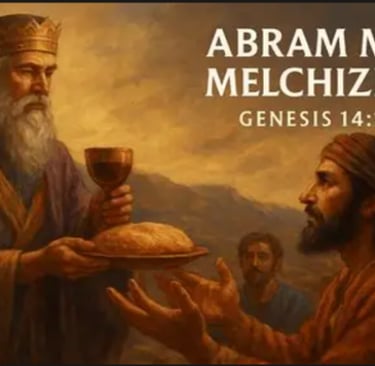
Melchizedek the Blessing & Birthright
This article is the result of some interesting questions that were brought to my attention a few years back (about 45 years at this point). I will begin by citing the scriptures, and then I will state the questions.
1. The first question comes from Hebrews 7:1-4 For this Melchizedek, king of Salem, priest of the most high God, who met Abraham returning from the slaughter of the kings and blessed him. To whom also Abraham gave a tenth part of all; first being by interpretation King of righteousness, and after that also King of Salem, which is, King of peace. Without father, without mother, without descent, having neither beginning of days, nor end of life. but made like unto the Son of God; abides a priest continually. Now consider how great this man was, unto whom even the patriarch Abraham gave the tenth of the spoils.”... “of whom we have many things to say, and hard to be uttered, seeing ye are dull of hearing."... This should make one curious and want to know more about this person Melchizedek. So, the question is: what more could the Apostle Paul have told us about Melchizedek if the Hebrews hadn’t been so dull of hearing? Especially considering that in the Old Testament Melchizedek is only mentioned two times once in Genesis 14:18 and the other in Psalms 110:4... “Without father and mother, without descent, having neither beginning of days, nor end of life.” What, is he still living?
2. The second question comes from Genesis 9:20-27 “And Noah began to be a husbandman, and he planted a vineyard: And he drank of the wine and was drunken; and he was uncovered within his tent. And Ham, the father of Canaan, saw the nakedness of his father, and told his two brethren without. And Japheth took a garment, and laid it upon both their shoulders, and went backward, and covered the nakedness of their father; and their faces were backward, and they saw not their father's nakedness. And Noah awoke from his wine and knew what his younger son had done to him. And he said, ‘Cursed be Canaan; a servant of servants shall he be unto his brethren.” And the question becomes: why does Noah curse Canaan for something that apparently his father Ham did? This is the only place that I know of in the scriptures where the perpetrator of a crime seems to get off free, and someone else gets punished. Why would Noah do that? Does this seem like the kind of man with whom the Lord would choose to save mankind from extinction? Besides, is there really something wrong with seeing your father naked? Do we have a scripture that states that a man should not see his father naked?
3. The third question comes from 1Chronicles 5:1&2 "Now the sons of Reuben the firstborn of Israel, (for he was the firstborn; but forasmuch as he defiled his father's bed, his birthright was given unto the sons of Joseph the son of Israel: and the genealogy is not to be reckoned after the birthright. For Judah prevailed above his brethren, and of him came the chief ruler; but the birthright was Joseph's". What does this mean? What is this genealogy, and birthright?
These three questions may seem unrelated, but they are wonderfully connected. Once you begin to unravel them, the Bible reveals an extraordinary family drama. To see it, start by putting yourself in Noah and Shem's place: the world has just been destroyed by a great flood, and only you, your five sons, their wives, and a Zoo in the ark have survived. Your family is now the only family on earth. What plan would you establish among your children to divide the land fairly?
You might say, “That is simple enough—I would divide the land equally among my sons, and they would do the same with their children.” Noah had three sons: Shem, Ham, and Japheth. Shem had five sons: Elam, Asshur, Arphaxad, Lud, and Aram (Genesis 10:22). But if the land is divided equally, where do the parents live? And when they die, who receives their property? Life expectancy quickly complicates the matter. Dividing the land five ways may seem fair—until each son marries and begins his own household. Perhaps a better method would be to divide the land by the number of children in the family, plus one additional share for the father. Then, when the father dies, if the firstborn son is faithful, God-fearing, and has not angered his father, he would receive the father’s portion. As the eldest and natural head of the family, he would need greater resources to bless and care for the rest of the household. Thus begins the law of the firstborn, later stated by Moses in Deuteronomy 21:17: “He shall acknowledge the firstborn, by giving him a double portion of all that he hath.”
Now let's see what happened to the genealogy. In Genesis 11:10-11 we read "These are the generations of Shem: Shem was a hundred years old, and begat Arphaxad 2 years after the flood: And Shem lived after he begat Arphaxad 500 years and begat sons and daughters."
WHO GETS SHEM'S LAND?
You might say, “Simply give it to the firstborn.” But what if the firstborn dies before you? Then it would pass to his firstborn—but what if he also dies first? This problem continues for generations. In fact, Shem outlived nine generations of descendants. Imagine how difficult it would be to decide who should receive the inheritance. You would have to trace the firstborn line through ten generations, while also considering whether each firstborn was worthy to become head of the family. So who among Shem’s descendants finally outlived him? Abraham was the first in Shem’s lineage to live beyond Shem’s death. Technically, Eber—whose name is associated with the term Hebrew—also lived beyond Shem, but as Jacob later blessed Ephraim over Manasseh and bypassed Joseph, Shem likewise had the right to divide his land as he saw fit, even while Eber was still alive; see Genesis 48:19.
ABRAHAM FIRST TO OUTLIVE SHEM!
So Arphaxad must inherit Shem’s land—right? Wrong. Why not? Let’s look at the dates. In Genesis 12:13-14 we read, “And Arphaxad lived thirty-five years, and begat Salah: And Arphaxad lived after he begat Salah 403 years, and begat sons and daughters.” Arphaxad was 35 when Salah was born and lived another 403 years, so he died at 438. But Shem lived 500 years after Arphaxad was born, which means Shem outlived Arphaxad by 62 years. Therefore, Arphaxad could not have taken possession of Shem’s land. So, what happens next?
IS ABRAHAM FIRST BORN?
Let’s look more closely at Abraham’s genealogy. In Genesis 11:12-24, we find nine generations from Shem to Terah, Abraham’s father. In nearly every case, the son is born when the father is about thirty years old—until we come to Terah. This suggests that, for the most part, the genealogy likely followed the firstborn line down to Terah. If so, Abram would have been wealthier than most because he came from the firstborn line, which received a double portion of the inheritance. Is this what we find? Yes. Genesis 13:2 says, “Abram was very rich in cattle, in silver, and in gold.” He was also likely rich in land before leaving Mesopotamia. In Acts 7:3, Stephen declares, “Brothers and fathers, listen to me! The God of glory appeared to our father Abraham while he was still in Mesopotamia, before he lived in Haran, and told him, ‘Leave your country and your kindred and go to the land I will show you.’ So Abraham left the land of the Chaldeans and settled in Haran. And after his father died, God brought him out of that place and into this land where you are now living.”
This may also explain how Abraham acquired so much gold and silver—perhaps by selling inherited land. Now consider the faith required when the Lord told Abram to leave his father’s house for a land He would show him. Abram was already the leader of a large family, so leaving behind what he possessed for only a promised future was no small decision. But what would you do if you knew that your many-times-great-grandfather Shem was still alive, seeking the right person to receive his inheritance and lead not merely a large household, but the entire human family?
With this thought in mind let us continue to investigate the genealogy of Abraham. Turn with me again to Genesis 11:27 Now these are the generations of Terah: Terah begat Abram, Nahor, and Haran: and Haran begat Lot." So, we see here that Abram is first born, and so as long as Abram does nothing to mar his inheritance, Abraham should inherit Shem's land right?! Wrong!
ABRAHAM IS NOT TARAH’S FIRST BORN!
Let’s take a closer look. Genesis 11:26 says, “And Terah lived seventy years, and begat Abram, Nahor, and Haran.” Should we assume they were triplets? I do not think so. Terah lived to be 205 and died in Haran, likely the city of his son Haran, where his family may have been caring for him. Abraham was 75 when Terah died (see Genesis 12:4). Subtracting Abraham’s age from Terah’s age at death—205 minus 75—shows that Terah was 130 when Abram was born. That means Terah was 130 when his wife gave birth to Abram; and we thought Abraham was old when Isaac was born at 100! This also leaves a 60-year gap between Abram and Terah’s firstborn, whom we believe was Haran. If so, Abram’s nephew Lot would have been about Abraham’s age and may have been the rightful heir to Shem’s throne and land.
Genesis 15:7 says, “And he said unto Abram, I am the LORD that brought you out of Ur of the Chaldees, to give you this land to inherit it.” But if Lot was the rightful heir, why would Abraham take him along? A scheming person might have thought, “Leave Lot behind and claim the inheritance yourself.” After all, Jacob later used deception to receive Isaac’s blessing from Esau. But that was not Abraham’s character. Abraham brought the rightful heir with him, as if saying to the Lord, “This is the rightful heir. If You intend to give this land to me and make me head of the family, then You must arrange the circumstances to make it so.” This reveals the depth of Abraham’s faith in the Lord. If the Lord promised the land to him, then the Lord could also bring it about in harmony with the inheritance laws likely established by God through Noah.
An interesting incident supports the idea that Abraham knew Lot was the rightful heir. In Genesis 13:9, Abraham and Lot separate because of conflict between their servants. Abraham gives Lot first choice of the land, saying, “Let there be no strife, I pray, between me and you, and between my herdsmen and your herdsmen; for we are brethren. Is not the whole land before you? Separate yourself, I pray, from me: if you take the left hand, then I will go to the right; or if you depart to the right hand, then I will go to the left.” Lot then chooses the well-watered plain of Jordan, where Sodom and Gomorrah were located—in other words, Lot chose the best land. Some may see Abraham’s offer simply as an act of generosity, but I believe there were two reasons behind it: Abraham’s goodness and Lot’s right.
In time, war broke out in the land, and Lot was taken captive. Abraham gathered an army and rescued him from the enemy. Melchizedek, the king and priest of the land, saw what had happened between Abraham and Lot. I believe he concluded that the land should be entrusted to someone strong enough to defeat the enemy and keep it safe. Only then, I believe, did God make an oath to Abraham, because the circumstances had been arranged so that Abraham now had a legitimate claim to the land through Melchizedek’s blessing.
BUT THE LAND OF CANAAN?
By now you may be thinking, “Wait—Canaan’s land? Wasn’t that the land inherited by Canaan, Ham’s son?” Since Canaan was not descended from Shem, why would Abraham expect to inherit the land of Canaan? This brings us to our second question: why was Canaan cursed by Noah for something his father Ham had done?
Let’s take a closer look at Canaan by reading Genesis 9:18-27: “And the sons of Noah, that went forth from the ark, were Shem, Ham, and Japheth; and Ham is the father of Canaan. These are the three sons of Noah: and of them was the whole earth overspread. And Noah began to be a husbandman, and he planted a vineyard: And he drank wine and was drunken; and he was uncovered within his tent. And Ham, the father of Canaan, saw the nakedness of his father [Noah], and told his two brethren without. And Shem and Japheth took a garment, laid it upon both their shoulders, went backward, and covered the nakedness of their father; their faces were turned away, and they did not see their father’s nakedness. And Noah awoke from his wine and knew what his younger son had done unto him. And he said, Cursed be Canaan; a servant of servants shall he be unto his brethren. And he said, blessed be the God of Shem; and Canaan shall be his servant. God shall enlarge Japheth, and He shall dwell in the tents of Shem; and Canaan shall be his [Shem’s] servant.”
WHY CURSE CANAAN?
A close reading of this account raises several difficult questions. First, why did Noah curse Canaan when the text does not say Canaan did anything wrong? Second, if Ham’s deed was so wicked, why was Ham not cursed instead? Third, is there truly anything wrong with seeing one’s father naked, especially when all involved were men? The account is undeniably strange. If I did not know better, I might think Noah was still drunk when he made this decision—or perhaps becoming senile, since he was likely between 700 and 900 years old when he pronounced this blessing and curse upon his children.
Personally, I think the text as we have it may preserve only part of the story. When these questions are examined carefully, the answers bring Genesis chapters 9–15 into sharper focus and may have far-reaching implications. For now, however, let us proceed one step at a time and begin with the third question: what was so serious about Ham seeing his father’s nakedness? Scripture does not say that merely seeing one’s father uncovered is itself the issue. However, Leviticus 18:6-9 uses the phrase “uncover nakedness” as a legal expression for a grave violation of family boundaries. In that context, the phrase refers not to accidental sight, but to an act that dishonors the family order and violates a close household relationship. A related passage in Leviticus 20:11 reinforces this legal meaning. From this, I suggest that Ham’s offense was more serious than simply observing Noah uncovered. The repeated emphasis that Ham was the father of Canaan may indicate that Canaan’s status is central to the account. This would explain why Canaan is singled out when no other grandchild of Noah is mentioned in the passage. In that reading, Noah’s curse addresses an inheritance problem: Canaan’s place within the family order was disputed, and Noah’s judgment determined that he would not receive an independent share, but would instead be placed under Shem’s authority. This interpretation also helps explain why the passage begins by identifying Ham specifically as Canaan’s father and why Canaan becomes the focus of Noah’s pronouncement.
WHAT TO DO WITH AN ILLEGITIMATE CHILD?
As we answer the third question, the first two begin to fall into place. The first question was this: why did Noah curse Canaan when the text does not describe Canaan committing any wrongdoing, apart from being Ham’s son? If this interpretation is correct, that connection is the key: Canaan’s birth placed him outside the accepted inheritance order. Noah and his sons had already established principles for inheritance, but Canaan’s status raised a difficult question: whose rightful son was he for purposes of inheritance? Under this reading, Canaan was cursed because he had no legitimate claim to an independent inheritance. Therefore, as the account states, he would become “a servant of servants.”
You may ask, then, why Scripture calls it the “land of Canaan.” The simple answer is that Canaan’s descendants settled there. However, occupying the land did not necessarily mean they held the legal right of possession. Seen this way, Noah’s dilemma becomes clearer. I believe he did the best he could for Canaan by placing him under Shem, whom Noah blessed with the promised seed—the one through whom all curses would ultimately be removed. This understanding removes any sense of vindictiveness from Noah’s actions and portrays him instead as a merciful father seeking to bless each of his sons as fully as possible.
Let’s consider another reason to believe that the land of Canaan was actually Shem’s land. We have already seen in Genesis 9:27 that Canaan was to serve Shem. When Shem gave his sons their inheritances, they would naturally go to their own territories, while Shem kept a portion for himself. Since Noah had placed Canaan under Shem, Canaan would have remained with Shem. Over time, as Shem’s sons settled elsewhere, Shem’s own land would have been populated by Canaan’s descendants. For that reason, it became known as the land of Canaan—not necessarily because they owned it, but because they lived there. Therefore, Abraham, as a legitimate descendant of Shem, would still have been in line to inherit it.
There is still another reason to believe the land belonged to Shem rather than Canaan. As noted earlier, Noah blessed Shem with the messianic lineage—the seed through whom all curses would ultimately be removed. As Shem grew old, the Lord sent Abraham to inherit the land and blessed him with that promised seed. In this sense, God was sending the one through whom the curse would be removed. Deuteronomy 23:2 adds another important principle: “A bastard [one of illegitimate birth] shall not enter into the assembly of Jehovah; even to the tenth generation.” Significantly, Abraham is the tenth generation from Shem. Although we cannot trace Canaan’s ten generations with certainty, we can trace Shem’s line, and Abraham stands at the tenth generation. This suggests that the curse on Canaan’s descendants was ending around Abraham’s time, as the promised seed was being introduced. This may explain why Abraham insisted on paying for Sarah’s burial plot instead of claiming legal ownership of the land. It also helps explain Stephen’s statement that God gave Abraham “no inheritance in it, not even a foot of ground,” but “promised to give it to him as a possession and to his offspring after him,” even though Abraham still had no child (see Acts 7:5 and Genesis 23).
This is not the only place where the law concerning illegitimate birth appears to matter. It also appears in King David’s lineage. David was the tenth generation from the union of Judah and Tamar, which produced Pharez and Zarah (see Genesis 38). This may explain why no king came from Judah until David, even though Genesis 49:10 says, “The scepter will not depart from Judah, nor a lawgiver from between his feet, until Shiloh comes,” and that the nations would obey him. The people chose Saul as king, but after the ten-generation period had passed, the Lord gave them His chosen king: David.
Another example of the ten-generation pattern appears between God’s covenant with Abraham and Israel’s entrance into the promised land. I believe this is indicated in Jesus’ genealogy in Matthew 1:2-5. If we ask how to know when ten generations had passed from Abraham to Israel’s possession of the land, the answer appears at the generation of Boaz, who was born to Salmon and Rahab. Thus, the Canaanites may have become legitimate occupants of the land in Abraham’s day, after Shem’s death; however, because they later fell into iniquity, the Lord gave the land to Israel, just as He had promised. Even then, God delayed Israel’s inheritance until Genesis 15:16 was fulfilled and “the iniquity of the Amorites” had reached its fullness. In the same way, the Lord later judged Israel after they rejected and crucified Jesus. Yet Isaiah speaks of a time of restoration, declaring in Isaiah 40:2, “Speak tenderly to Jerusalem and proclaim to her that her warfare has been accomplished, that her iniquity has been paid for, that she has received from the LORD’s hand double for all her sins.”
THROUGH ABRAHAM'S EYES
Some of you may have noticed that I am suggesting Abraham knew the Lord was offering him the land of Canaan before he entered it. That may raise an obvious objection: Paul says in Hebrews 11:8, “By faith Abraham, when he was called to go out into a place which he should after receive for an inheritance, obeyed; and he went out, not knowing whither he went.” Should we then conclude that Abraham did not know where the promised land was?
At first glance, Hebrews may seem to say that. Yet we still need to reconcile it with the Genesis account. In Genesis 11:31 through 12:5, we read that “Terah took Abram his son, Lot the son of Haran, his grandson, and Sarai his daughter-in-law, Abram’s wife, and they set out from Ur of the Chaldeans to go to the land of Canaan. But when they came to Haran, they settled there.” After Terah died in Haran, the Lord again called Abram to leave his country, kindred, and father’s house for the land He would show him, promising to make him a great nation and to bless all the families of the earth through him. Abram obeyed, taking Sarai, Lot, their possessions, and the people they had acquired in Haran, and they set out for the land of Canaan; and into Canaan they came.
The key point is that Terah took Abram and Lot to go to the land of Canaan, but he died before reaching it. This suggests that Terah, Abraham’s father, knew where he was going. During the journey, Terah—who was over 200 years old—apparently became ill, and the family stopped in Haran. That name is significant: Haran was Terah’s firstborn son and Lot’s father. After Terah died there, Abram completed the final stage of the journey with his family and entered the land of Canaan, the destination his father had originally intended to reach. This strongly suggests that Abraham also knew where he was going.
How, then, should we understand Hebrews 11:8, which says Abraham went out “not knowing whither he went”? I believe the answer is straightforward: Abraham may have known that Canaan was the destination, but because he had never been there, he likely did not know the route apart from the Lord’s guidance and the help of others.
With that in mind, I believe Shem may have contacted Haran—Terah’s firstborn son and closest living relative—to arrange a family meeting about the inheritance of Shem’s land. Haran may then have brought his own firstborn son, Lot, to Ur to inform Terah. After delivering the message, Haran died. Terah then took Abram, his third son, along with Lot, his firstborn grandson, and set out for Canaan to meet Shem and discuss the inheritance. On the way, Terah stopped in Haran, likely to settle matters after his son’s death and to tell relatives that the journey had become too difficult. Terah also died there, apparently overcome by the journey.
LOT'S REDEMPTION
This reasoning may sound both plausible and surprising, but it raises an important question: how did Abraham come to inherit the land if, as argued so far, Lot appeared to be the rightful heir? I believe Abram inherited it through a process of redemption. In Genesis 13:7-9, Abraham and Lot were living in the promised land when conflict arose between their servants. Abraham allowed Lot to choose his portion first, and Lot chose the well-watered plain of Jordan, where Sodom and Gomorrah were located. Then, in Genesis 14, several kings in the land went to war. The kings of Sodom and Gomorrah rebelled against Chedorlaomer king of Elam, who attacked them, defeated them, and carried away spoil—including Lot, Abram’s nephew. When Abram heard that Lot had been taken captive, he armed 318 trained servants born in his household, pursued the enemy, defeated them by night, and recovered Lot, his possessions, the women, and the people.
THE OATH BOUND COVENANT
At this point in the narrative, Melchizedek meets Abraham and blesses him with bread and wine. Immediately afterward, God establishes His oath-bound covenant with Abraham. Why are these events placed so closely after the battle of the kings? I believe the connection is deliberate. This is the moment when Shem—whom I, along with many others, understand to be Melchizedek—recognizes that God is blessing Abraham rather than Lot. After all, Lot had been taken captive by the enemy, and Abraham had rescued him. If Abraham saved Lot’s life, then Lot was indebted to Abraham, even for his very life.
Now consider the matter from Shem’s perspective. Could Shem place the land under Lot’s authority when Lot had proven unable to defend himself against the enemy? Surely he would entrust it instead to someone strong enough to defeat the enemy and preserve the land in safety. For this reason, I believe God did not make His oath to Abraham until this moment, when the circumstances had unfolded in such a way that Abraham now possessed a legitimate claim to the land through the blessing given by Shem, that is, Melchizedek.
SHEM = MELCHIZEDEK
This brings us back to our first question: what more might Paul have told us about Melchizedek if the Hebrews had not been so dull of hearing? After all, the Old Testament mentions Melchizedek only twice—once in Genesis 14:18 and again in Psalm 110:4. I have already suggested that Shem and Melchizedek were one and the same, and much of the foundation for that view has now been laid. Let us briefly review the main points and add a few more.
1. Melchizedek was a priest whom even Abraham recognized by giving him tithes. In Hebrews 7:4-7, Paul writes, “Now consider how great this man was, unto whom even the patriarch Abraham gave the tenth of the spoils... But he whose descent is not counted from them received tithes of Abraham and blessed him that had the promises. And without any contradiction the less is blessed of the greater.” Paul’s point is clear: Melchizedek was greater than Abraham. How could that be? In that world, greatness was closely tied to one’s father and lineage. Aside from Shem, the only person then living who might have been considered greater than Abraham was Eber, Shem’s great-grandson, from whom the term Hebrew is derived (see Genesis 14:13). While Melchizedek could possibly have been Eber, I do not believe that fits the evidence. What God was promising Abraham was what Shem would still be in possession of.
2. If Melchizedek had been one of Canaan’s descendants, as most of inhabitants of Canaan were, he would have fallen under the restriction stated in Deuteronomy 23:2: “A bastard [one of illegitimate birth] shall not enter into the congregation of the Lord; even to his tenth generation.” For that reason, Melchizedek could not reasonably have been a descendant of Canaan, since such a person could not serve as a priest of the Lord for at least ten generations. Who, then, in the region of Canaan would Abraham have considered worthy to receive his tithe? As noted earlier, we would expect Shem to be in that area, because Noah’s blessing in Genesis 9:27 says, “God shall dwell in the tents of Shem; and Canaan shall be his servant.” Thus, Noah either appointed or recognized Shem as the Lord’s high priest and as head of the human family after Noah’s death. It is also worth noting that Noah died only two years before Abraham was born.
3. I know of only one major objection to identifying Melchizedek with Shem: Paul’s statement in Hebrews 7:3 that Melchizedek was “without father, without mother, without descent, having neither beginning of days nor end of life.” At first glance, this may seem to rule out Shem. However, I do not think the objection is difficult to answer. Those who raise it usually understand Paul to mean that Melchizedek had no recorded parents, genealogy, birth, or death. Since Scripture records Shem’s father and the length of his life, they conclude that Melchizedek cannot be Shem. I believe that conclusion misunderstands Paul’s point.
The mistake, I believe, is in assuming Paul was referring to the absence of a scriptural record of Melchizedek’s parents, birth, genealogy, or death. Instead, Paul appears to be comparing the Levitical priesthood with the Melchizedek priesthood. The Levitical priesthood had both age limits and lineage requirements. This corresponds to Paul’s phrase “having neither beginning of days nor end of life,” because Melchizedek—if he was Shem—was far beyond the 50-year age limit associated with Aaronic service in Numbers 4:3, being about 560 years old when he blessed Abraham. Likewise, the Aaronic priesthood required descent from Aaron, which corresponds to Paul’s words “without father, without mother, without descent” (Hebrews 7:3). In other words, the Melchizedek priesthood was not passed from father to firstborn son as the Levitical priesthood was. It was not dependent on genealogy, and that, I believe, is Paul’s point.
2 QUESTIONS ANSWERED 1 TO GO
So far, I believe we have answered two of our original questions. The first came from Hebrews 5:10-11, where Christ is described as “called of God a high priest after the order of Melchizedek.” We have, I believe, uncovered a little more of what the apostle Paul might have told the Hebrews if they had not been so dull of hearing. It is also worth noting that what Melchizedek did with Abraham in serving bread and wine foreshadowed what Jesus did for us at the Last Supper: He united us with Himself in the Melchizedek priesthood. This view is also ancient; according to Wikipedia, “Chazalic literature unanimously identifies Melchizedek as Shem.” The second question came from Genesis 9:20-27, where Noah curses Canaan for what Ham, Canaan’s father, had done. We have seen that Noah was not acting cruelly; rather, he intended to bless his sons. Yet Ham had brought a curse upon Canaan through his illicit relationship with Noah’s wife.
Now one question remains, drawn from 1 Chronicles 5:1-2: “Now the sons of Reuben the firstborn of Israel—for he was the firstborn, but because he defiled his father’s bed [the same offense committed by Ham], his birthright was given to the sons of Joseph the son of Israel; and the genealogy is not to be reckoned after the birthright. For Judah prevailed above his brothers, and from him came the chief ruler; but the birthright was Joseph’s.” What does this mean? What are the genealogy and the birthright, and what does it mean that “the genealogy is not to be reckoned after the birthright”? Up to this point, the genealogical blessing and the birthright have both followed the firstborn line from Shem to Abraham, except in Abraham’s case, where the inheritance was obtained through his redemption of Lot.
JACOB AND ESAU
Let us turn to the account of Isaac’s two sons, Jacob and Esau. In Genesis 25:27-34, we read that Esau was a skillful hunter and a man of the field, while Jacob was a quiet man who dwelt in tents. Isaac loved Esau because he enjoyed his venison, but Rebekah loved Jacob. One day, when Esau returned from the field exhausted, Jacob was cooking lentil stew. Esau asked for some, and Jacob replied, “Sell me your birthright this day.” Esau answered, “Behold, I am at the point to die: and what profit shall this birthright do to me?” So Esau swore to Jacob and sold him his birthright. Then Jacob gave him bread and lentil stew; Esau ate, drank, rose, and went his way. Thus, Esau despised his birthright.
This account shows how Esau’s carelessness and fleshly weakness cost him his birthright. The birthright was the double portion of land belonging to the firstborn. Later, when Isaac was old, he desired to give his blessing to Esau. But Rebekah—and apparently the Lord—intended that Jacob receive it. Because Rebekah and Jacob lacked faith that the Lord would work matters out rightly, Rebekah persuaded Jacob to deceive his father and obtain the blessing. That deception cost Jacob dearly, for he was later deceived into marrying Leah instead of Rachel. What, then, was contained in the blessing Jacob sought so urgently? In Genesis 27:27-29, Isaac blesses him with heaven’s dew, the earth’s richness, abundant grain and wine, rule over peoples and nations, authority over his brothers, and blessing upon those who bless him. From this account, we see that the position of head of the family was transmitted through the blessing. In Isaac and Jacob’s case, this meant headship over the whole human family: “Let people serve you, and nations bow down to you.”
In verses 36-37, Esau says, “Is not he rightly named Jacob? For he has supplanted me these two times: he took away my birthright; and behold, now he has taken away my blessing.” When Esau asks whether any blessing remains for him, Isaac replies, “Behold, I have made him your lord, and all his brethren have I given to him for servants; and with corn and wine have I sustained him; and what shall I do now unto you, my son?”
From Jacob and Esau’s account, we see that the birthright and the blessing normally belonged together as part of the firstborn inheritance. Yet a person’s conduct could cause him to lose either one or both. Paul later uses Esau as a warning to the Church of the firstborn in Hebrews 12:15-17: “Lest there be any fornicator, or profane person, as Esau, who for one morsel of meat sold his birthright... For you know how that afterward, when he would have inherited the blessing, he was rejected: for he found no place of repentance, though he sought it carefully with tears.” Brethren, we are the antitypical firstborn. Let us not lose our inheritance through the lusts and desires of the flesh.
REUBEN, JOSEPH, AND JUDAH
We now return to Jacob’s sons, where our original question arose. In Genesis 49:3-4, Jacob blesses his sons and says, “Reuben, you are my firstborn, my might, and the beginning of my strength, the excellency of dignity, and the excellency of power: unstable as water, you shall not excel; because you went up to your father’s bed and defiled it: he went up to my couch.” I believe Reuben committed essentially the same kind of offense as Ham, Noah’s son, though apparently without the added consequence of a child being born. In Reuben’s case, the woman was not Jacob’s wife but his concubine Bilhah. Even so, Jacob considered the offense serious enough for Reuben to forfeit his birthright. The question, then, is this: among Jacob’s remaining eleven sons, who should receive the birthright, and who should receive the blessing?
Deuteronomy 21:15-17 gives the law concerning the right of the firstborn: “If a man have two wives, one beloved, and another hated... he may not make the son of the beloved firstborn before the son of the hated, which is indeed the firstborn: but he shall acknowledge the son of the hated for the firstborn, by giving him a double portion of all that he has... the right of the firstborn is his.”
This law fits Jacob’s situation to a tee. Jacob had two wives: Leah, who was unloved, and Rachel, whom he loved. But Reuben, Leah’s firstborn, defiled his father’s bed and forfeited the birthright. Should it then pass to Jacob’s second-born son, or to the firstborn son of his beloved wife? This must have been a difficult question for Jacob. Since Jacob effectively had two firstborn sons—Reuben through Leah and Joseph through Rachel—it seems logical that he would give the birthright to Joseph. I believe this is the matter Paul refers to in Hebrews 11:21: “By faith Jacob, when he was dying, blessed both the sons of Joseph; and worshiped, leaning upon the top of his staff.” Here the blessing is not the genealogical blessing, but the transfer of the birthright. Genesis 48:5 explains it: “And now your two sons, Ephraim and Manasseh... are mine; as Reuben and Simeon, they shall be mine.” In other words, Jacob counted Joseph’s two sons as his own, giving each an equal portion of land and thereby giving Joseph the double portion. This is also reflected in verse 22: “Moreover I have given to thee one portion above thy brethren, which I took out of the hand of the Amorite with my sword and with my bow.”
But what does Paul mean when he says that “Jacob worshiped, leaning upon the top of his staff”? I believe the point is that Jacob recognized the Lord was blessing Joseph. Joseph’s staff, so to speak, had risen above the staffs of his brothers—and even above Jacob’s own—fulfilling Joseph’s dream in Genesis 37:9-10: “The sun and the moon and the eleven stars made obeisance to me.” In that sense, I believe Paul is saying that Jacob did indeed bow before the evidence of God’s choice. Therefore, Jacob concluded that the birthright should go to Joseph.
THE BLESSING OF THE GENEALOGY
But what should Jacob do with the blessing of family headship and the genealogy? Should Joseph receive that as well? From 1 Chronicles 5:1-2, we know that “the genealogy was not to be reckoned after the birthright,” because “Judah prevailed above his brethren, and of him came the chief ruler.” But why Judah? Why not Simeon, Jacob’s second-born son? To answer that, consider the blessing Jacob gave Simeon in Genesis 49:5-7: “Simeon and Levi are brethren; instruments of cruelty are in their habitations... Cursed be their anger, for it was fierce; and their wrath, for it was cruel: I will divide them in Jacob and scatter them in Israel.” That sounds more like a curse than a blessing. What had they done to deserve it?
Recall that Simeon and Levi had a sister, Dinah, who had been defiled by Shechem, a Hivite prince, before marriage. Shechem then sought to do the honorable thing by marrying her, and Dinah apparently consented. But Simeon and Levi refused to accept this. Instead, they devised a plan to have all the men of the city circumcised; then, while the men were still in pain, they killed every male in the city.
Jacob’s conclusion was that the promised seed could not come through men of such a character. So what about Judah, his fourth son? In Genesis 37, when Jacob’s sons plotted to kill Joseph, Judah intervened and said, “What profit is it if we slay our brother, and conceal his blood? Come, and let us sell him to the Ishmaelites, and let not our hand be upon him; for he is our brother and our flesh.” Reuben was also noble in this matter, since he intended to rescue Joseph. Since Reuben and Judah appear more honorable than the others, it seems likely that Simeon and Levi were among the main instigators of the plot against Joseph. Levi’s later scattering in Israel as the priestly tribe may correspond to Jacob’s words in Genesis 49. Simeon also appears especially culpable, since Joseph later kept him in prison when he sent the other brothers back to their father.
JUDAH MOST NOBLE
When famine forced Jacob to send his sons back to Egypt for more food, they had already returned without Simeon and now had to bring Benjamin with them. At this point, Judah showed himself the most noble and took responsibility for the situation. In Genesis 43:8-9, he tells Israel, “Send the lad with me, and we will arise and go; that we may live, and not die, both we, and you, and also our little ones. I will be surety for him; of my hand shall you require him: if I bring him not unto you, and set him before you, then let me bear the blame forever.” Later, when they returned to Egypt and Joseph arranged matters so that Benjamin would be kept behind, Judah fulfilled his pledge by offering to take Benjamin’s place as Joseph’s servant. In Genesis 44:32-33, he says, “Your servant became surety for the lad unto my father... Now therefore, I pray, let your servant abide instead of the lad a bondsman to my lord; and let the lad go up with his brethren.” In this, Judah showed that he had learned from his earlier sin in selling Joseph into slavery. He was now willing to enter servitude himself in place of the other son of the beloved wife, even though he was not wholly at fault in this later situation. Therefore, I believe Jacob saw Judah as worthy to receive the blessing and the position of head of the family. Thus, the genealogy [of Jesus and] the family headship passed through Judah.
CONCLUSION
Let us now consider whether we have answered the questions with which we began. The first was this: what more might the apostle Paul have said about Melchizedek if the Hebrews had not been so dull of hearing? We have argued that Melchizedek was most likely Shem, Abraham’s many-times-great-grandfather, who was still alive during much of Abraham’s life.
The second question was why Noah cursed Canaan for what Ham, Canaan’s father, had done. Our conclusion is that Noah’s purpose was not to curse, but to bless. Canaan was already affected by the circumstances of his birth, understood here as the offspring of an illegitimate relationship between Ham and Noah’s wife. Given that situation, Noah did the best he could for Canaan by placing him under Shem, through whom the promised seed would come—the seed who would ultimately remove all curses.
The third question concerned the difference between the blessing and the birthright. We concluded that the birthright was the double portion of the father’s land, normally given to the firstborn unless he forfeited it through serious wrongdoing. The blessing, however, was different. It was not received merely by right of birth; it had to be entrusted to someone who proved fit to lead the family, as Abraham and Judah did. When the firstborn was wise and faithful, he would naturally receive both. This may also explain Shem and Japheth: Japheth appears to have been Noah’s firstborn and likely received the birthright, which may be reflected in the broad territory occupied by his descendants. Yet the blessing went to Shem, whose city, Jerusalem, will one day be the capital of the world. The blessing was his, because he proved himself the wisest of Noah’s sons.
What, then, does this mean for those who desire to be part of the heavenly firstborn, inheriting both heaven and earth? Paul gives the warning plainly in Hebrews 12:15-17: “Lest there be any fornicator, or profane person, as Esau, who for one morsel of meat sold his birthright... For you know how that afterward, when he would have inherited the blessing, he was rejected: for he found no place of repentance, though he sought it carefully with tears.” Whenever Scripture shows someone in the Messianic genealogy losing an inheritance, the reason for that loss should instruct us as well. Therefore, let us live according to our faith and press on to obtain the prize.
Blessings to all who read and understand this,
Jim Schucker
Call: Jim Schucker 808-754-8978 for help in understanding.