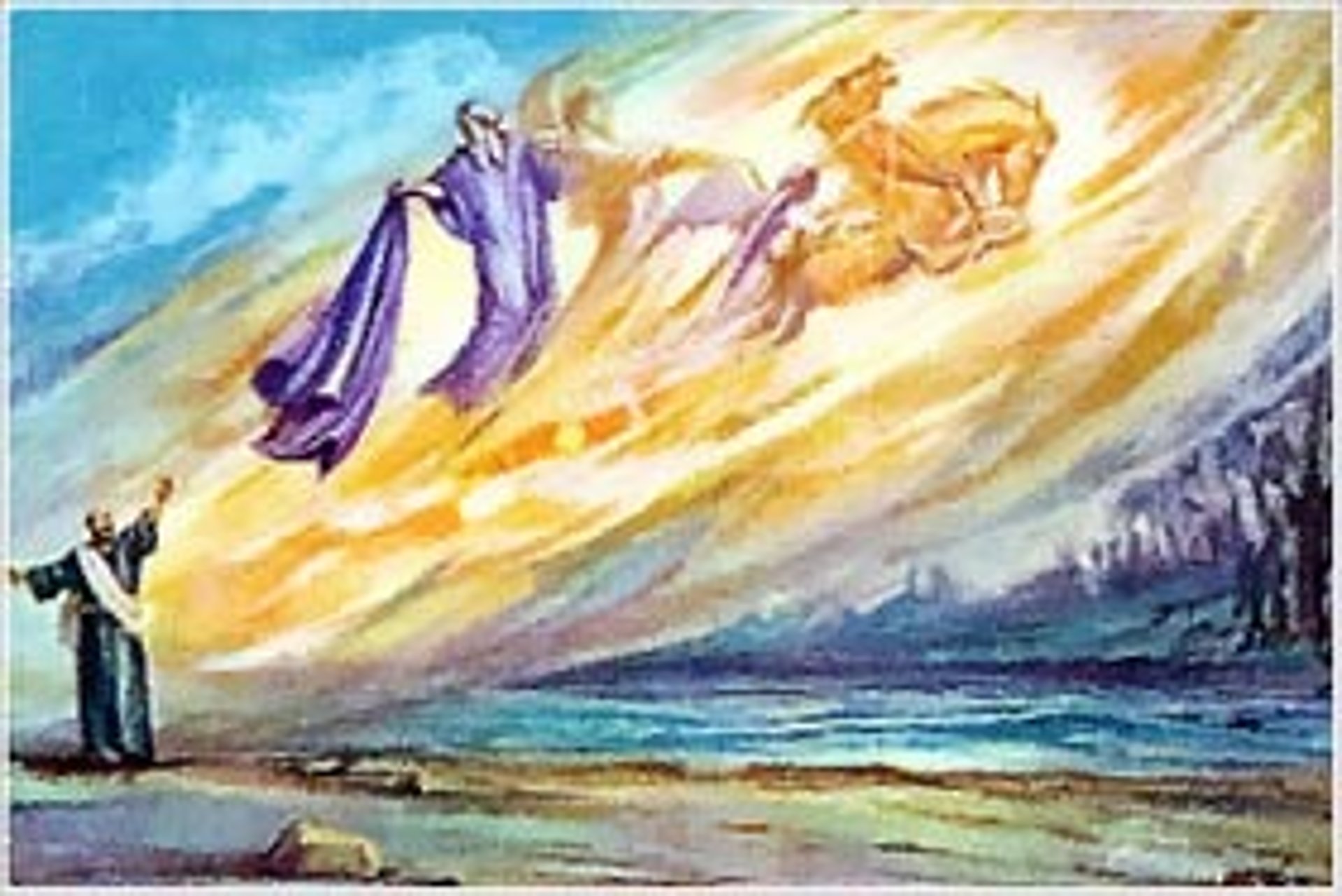
2 Kings 2 Elijah's Last Walk with Elisha
Explore the spiritual meaning of Elijah’s final journey with Elisha, Elijah’s being taken up to meet the Lord in the air, and why Elisha later cursed the forty-two youths who mocked him by saying, “Go up, you baldhead! Go up,” after which two female bears came out and mauled them. Also connected to the Three Watches, and Solomons Temple.
STORY PICTURES CONTAINING 3 WATCHES
James Schucker
The Lord has given us many stories in the Bible, and I believe He carefully guided the people within them to fulfill their appointed roles. For that reason, I believe He values our efforts to understand the spiritual meaning behind these accounts. This reflects 1 Corinthians 2:13: “We also speak these things, not in words taught by human wisdom, but in those taught by the Spirit, combining spiritual thoughts with spiritual words.”
This account is found in 2 Kings 2. When we seek to understand a scriptural story, we stand on firmer ground when its symbols are used consistently. Such accounts often carry rich prophetic meaning while also teaching sound moral principles. Together, they form interconnected parts of the larger story of the Gospel Age leading into the Kingdom Age. As 1 Peter 1:10-12 says: “Concerning this salvation, the prophets who foretold the grace to come to you searched and investigated carefully, 11trying to determine the time and setting to which the Spirit of Christ in which was in them was pointing when they predicted the sufferings of the Christ and the glories to follow. 12It was revealed to them that they were not serving themselves, but you, when they foretold the things now announced by those who preach the gospel to you by the Holy Spirit sent from heaven. Even the angels long to look into these things.”
Elijah and Elisha Introduction
2 Kings 2:1 “Shortly before the LORD took Elijah up to heaven in a whirlwind, Elijah and Elisha were on their way from Gilgal [starting from the 6th Church reformation under Luther. Time frame of Revelation 10] 2and Elijah said to Elisha, “Please stay here, for the LORD has sent me on to Bethel.” But Elisha replied, “As surely as the LORD lives and as you yourself live, I will not leave you. [#1]” So, they went down to Bethel. 3Then the sons of the prophets [#1 1260=1799 →First Watch] at Bethel came out to Elisha and said, “Do you know that the LORD will take your master away from you today?” “Yes, I know,” he replied. “Do not speak of it.”
4 And Elijah said to Elisha, “Please stay here, for the LORD has sent me on to Jericho.” But Elisha replied, “As surely as the LORD lives and as you yourself live, I will not leave you. [#2]” So, they went to Jericho. 5Then the sons of the prophets [#2 1290=1829 →Second Watch Luke 12:38] at Jericho came up to Elisha and said, “Do you know that the LORD will take your master away from you today?” “Yes, I know,” he replied. “Do not speak of it.”
6 And Elijah said to Elisha, “Please stay here, for the LORD has sent me on to the Jordan.” But Elisha replied, “As surely as the LORD lives and as you yourself live, I will not leave you. [#3]” So, the two of them went on. 7Then a company of fifty of the sons of the prophets [#3 1335=1874 →Third Watch Daniel 7:13] went and stood at a distance, [Watching in expectation of Elisha being taken up] facing Elijah and Elisha as the two of them stood by the Jordan. 8And Elijah took his cloak, rolled it up, and struck the waters, which parted to the right and to the left, so that the two of them crossed over on dry ground. [Separation message of the harvest in 1878]
At this point in the account, we want to notice in a list a few things I highlighted above.
Elisha’s devotion to following Elijah is evident: three times he refused to remain behind with the sons of the prophets, even when Elijah told him to stay. This suggests that the Lord may want us to see Elijah and Elisha as establishing the schools of the prophets in those places. Likewise, we should be devoted to following those who provide us meat in due season, for they may be among the Lord’s messengers.
We should consider what the Lord is revealing through the three cities and Jordan. Do the Scriptures mention three cities together elsewhere, especially in connection with the time of the end? The answer is clearly yes. The final three churches of the Gospel Age are grouped together in Revelation chapter three. These three stages of the church are also linked with the last three Seals and Trumpets, both of which are distinguished from the first four. Likewise, the final three parables of Matthew 13 are set apart in the same way.
The sons of the prophets repeated twice in the final two cities, “Do you know that the LORD will take your master away from you today?” This suggests they somehow understood that Elijah was about to “meet the Lord in the air,” while Elisha would remain behind for a time. Their words appear to dramatize the teaching in 1 Thessalonians 4:16–17: “…After that, we who are alive and remain will be caught up together with them in the clouds to meet the Lord in the air…” This also connects with Luke 12:38: “And if he shall come in the second watch [2nd watch=1829] or come in the third watch
3rd watch=1874] and find them so, blessed are those servants.”
Elijah’s act of taking his cloak, rolling it up, and striking the waters suggests the image of a scroll being rolled together. The mantle that covers us, like the robe of Christ’s righteousness, conveys a compact message that divides "the waters" both truth and people, as expressed in, “let them both grow together until the time of the harvest.” As Elijah and Elisha crossed the Jordan, they were also leaving Israel behind, suggesting the call, “come out of her my people,” since Israel had become corrupted. Therefore, the timing of this smiting event would antitypically correspond to 1878.
Interpreting 2 Kings 2
2 Kings 2:9 After they had crossed over, Elijah said to Elisha, “Tell me, what can I do for you before I am taken away from you?” “Please, let me inherit a double portion of your spirit,” Elisha replied. 10“You have requested a difficult thing,” said Elijah. “Nevertheless, if you see me as I am taken from you, it will be yours. But if not, then it will not be so.” 11As they were walking along and talking together [40 years Russell's preached 1876 to 1916 expecting to meet the Lord in the air.] suddenly a chariot of fire with horses of fire appeared and separated the two of them, and Elijah [Charles Russell October 31st 1916] went up into heaven in a whirlwind... [WW1]
The point suggested here is that those living during the harvest should recognize that the ‘rapture’ is underway. If they do, the Lord will regard them as part of the first-born church class, which receives the double portion—the firstborn portion—of immortality in the resurrection.
Their walking together represents the early harvest period, when the two classes are together until Elijah, represented by Brother Russell, is taken from Elisha in the whirlwind, which symbolizes World War One. We, as the Elisha class, recognize that this event has occurred and remain as part of the first-born class until our own death. At which time we also will meet the Lord in the Air. 1 Thessalonians 4:17
It is also significant that, when we count the miracles performed by Elijah and Elisha, Elisha performed twice as many. This double portion also appears in Rev 18:6: “Give back to her as she has done to others; pay her back double for what she has done; mix her a double portion in her own cup.”
A second form of the double portion appears in Revelation 8:13, where John is told of the three woes to come, corresponding to the final three trumpets. This is also reflected in the last three double woe plagues in Revelation 18:10, 15, and 19, where three double woes are pronounced by the harvest church upon Babylon. Note: some translations are inconsistent and do not render the word as “woe” in chapter 18.
Also note that the early church received the early rain—the truth given in the New Testament at the beginning of the Gospel Age. By contrast, the harvest church receives both the early and the latter rain, the harvest truth given through Brother Russell. Thus, it receives a double portion.
12 ...As Elisha watched, he cried out, “My father, my father, the chariots and horsemen of Israel!” And he saw Elijah no more. So, taking hold of his own clothes, he tore them in two. 13Elisha also picked up the cloak that had fallen from Elijah, and he went back and stood on the bank of the Jordan. 14Then he took the cloak of Elijah that had fallen from him and struck the waters. “Where now is the LORD, the God of Elijah?” he asked. And when he had struck the waters, they parted to the right and to the left, and Elisha crossed over. [entering back into the promised land of Israel after WW1]
After Elijah and Elisha left Babylonish Israel together, Elisha alone reentered the promised land of the Kingdom, suggesting the thought, “the kingdoms of this world have become the kingdoms of our Lord and of his Christ” (Rev. 11:15), which follows World War One. The question, “Where is the LORD, the God of Elijah?” points to his help in restoring the Jewish people to their homeland of Israel. This also connects with Israel crossing the Jordan under Joshua, entering the promised land, and going on to Jericho’s destruction. The same place that Elisha goes, not a coincidence. At times, it can be difficult to tell whether a symbolic action represents destruction or deliverance. The trumpets in Revelation appear severe, yet when properly understood, they reveal a beneficial purpose. Perspective is everything.
15 When the sons of the prophets who were watching him from Jericho saw what had happened, they said, “The spirit of Elijah rests on Elisha.” And they went to meet him and bowed down to the ground before him. 16“Look now,” they said to Elisha, “we your servants have fifty valiant men. Please let them go and search for your master. Perhaps the Spirit of the LORD has taken him up and put him on one of the mountains or in one of the valleys.” “Do not send them,” Elisha replied.
17 But when they pressed him to the point of embarrassment, he said, “Send them.” And they sent fifty men, who searched for three days but did not find Elijah. 18When they returned to Elisha, who was staying in Jericho, he said to them, “Didn’t I tell you not to go?”
What appears to be happening here is that Elijah is returning—essentially retracing his steps—to the schools of the prophets, which he likely helped establish. Why? To correct them for failing to advance in their understanding of Scripture. Antitypically, this represents todays Christians who failure is in not recognizing that the Lord does not return in the flesh; therefore, they should not be looking for a return in the flesh. Charles Russell tried to tell them, but they were not listening. This corresponds with Rev 3:18 “I counsel you to buy from Me gold refined by fire so that you may become rich, white garments so that you may be clothed and your shameful nakedness not exposed, and salve to anoint your eyes so that you may see.”
Note: These fifty men are likely the same captain and his fifty that were sent by King Ahaziah to retrieve Elijah in chapter one. 2Kings 1:15 This means they are still spiritually under the influence of the doctrines and beliefs of the beast and false prophet.
Elisha Inherits a Double Portion
[Elijah and Elisha Introduction] [Interpreting 2 Kings 2] [Elisha Inherits a Double Portion] [Elisha Heals the Waters of Jericho] [Elisha Mocked by 42 Children at Bethel]
[Elijah and Elisha Introduction] [Interpreting 2 Kings 2] [Elisha Inherits a Double Portion] [Elisha Heals the Waters of Jericho] [Elisha Mocked by 42 Children at Bethel]
2 Kings 2:19 Then the men of the city said to Elisha, “Please note, our lord, that the city’s location is good, as you can see. But the water is bad, and the land is unfruitful.” 20“Bring me a new bowl,” he replied, “and put some salt in it.” So, they brought it to him, 21and Elisha went out to the spring, cast the salt into it, and said, “This is what the LORD says: ‘I have healed this water. No longer will it cause death or unfruitfulness.’” 22And the waters there have been healthy to this day, according to the word spoken by Elisha.
“But the water is bad, and the land is unfruitful.” As the Jewish people were regathered to Israel, the land faced a serious water problem, which has largely been addressed today through desalination using reverse osmosis. As a result, the fig tree has put forth its leaves, showing that summer is near. Yet there is also a spiritual application. Jesus said, “ye are the salt of the earth,” and today, more than ever, the Jewish people appear to be beginning to listen to the gospel. This is also suggested in Song of Solomon 5:7-8 where the great company having their cloak taken away by the watchers, or those of the wise and foolish virgins Matt 25 the lord says “Truly I tell you, I do not know you” these who were not ready to be chosen go on to meet with the Jewish people called the ‘daughters of Jerusalem’ also Acts 15:17 “so that the remnant of men may seek the Lord, and all the Gentiles who are called by My name.”
“Bring me a new bowl,” he replied, “and put some salt in it.” This recalls Revelation 15:7: “Then one of the four living creatures gave the seven angels seven golden bowls full of the wrath of God, who lives forever and ever.” These bowls closely resemble those in Revelation 5:8: “When He had taken the scroll, the four living creatures and the twenty-four elders fell down before the Lamb. Each one had a harp, and they were holding golden bowls full of incense, which are the prayers of the saints.” These twenty-four bowls represent the twenty-four books of the Old Testament, which contain both the prayers of the saints and accounts of God’s wrath. Jesus’ words in Luke 5:37–39 provide further insight: “And no one pours new wine into old wineskins. If he does, the new wine will burst the skins, the wine will spill, and the wineskins will be ruined. 38Instead, new wine is poured into new wineskins. 39And no one after drinking old wine wants new, for he says, “The old is better.” Here, the wine represents the Word of God, and the New Testament explains the truths contained in the Old Testament—yet “the old is better.” In Revelation 15, the golden bowls may represent the six volumes of Studies in the Scriptures, which contain Brother Russell’s explanation of God’s wrath which was soon to be poured out upon the beast and false prophet then in 1914 ruling 84% of the earth’s surface. Finally, “and put some salt in it” connects with Jesus’ statement, “You are the salt of the earth” (Matthew 5:13), suggesting the preserving power of the truth contained in the six volumes of Studies in the Scriptures.
Elisha Heals the Waters of Jericho
2 Kings 2:23 From there, Elisha went up to Bethel, [#1 the first city that Elijah and Elisha went. Representing 1799 at Bethel] and as he was walking up the road, a group of boys came out of the city and jeered at him, chanting, “Go up, you baldhead! Go up, you baldhead!” 24Then he turned around, looked at them, and called down a curse on them in the name of the LORD. Suddenly two female bears came out of the woods and mauled forty-two of the boys.
Elijah continued retracing his steps through the schools of the prophets he had helped establish. Here, we find a group that had become even more corrupted. The boys jeered at him, saying, “Go up, you baldhead! Go up, you baldhead!” Spiritually, this suggests that they understood Elijah’s teaching about the church meeting the Lord in the air, yet mocked Elisha for holding a proper understanding of it.
The boys’ teaching was spiritually derived from the beast and the false prophet during the 42 months of the dark ages. This returns us to the point where Elisha and Elijah began this typical journey together in 1799. The beast and the false prophet are represented by the two she bears that mauled the boys. Spiritually this recalls Revelation 14:9-13 …“If anyone worships the beast and its image and receives its mark on his forehead or on his hand, 10he too will drink the wine of God’s anger, poured undiluted into the cup of His wrath. And he will be tormented with fire and sulfur [mauled] in the presence of the holy angels and of the Lamb. 11And the smoke of their torment rises forever and ever. Day and night there is no rest for those who worship the beast and its image, or for anyone who receives the mark of its name.” This forms part of the message taught by the harvest church.
25 And Elisha went on to Mount Carmel, and from there he returned to Samaria.
After Elijah, Mount Carmel remained associated with prophetic activity:
Elisha stayed there (2 Kings 2:25).
People visited prophets there on Sabbaths and new moons (2 Kings 4:23).
The Shunammite woman sought Elisha on Carmel when her son died (2 Kings 4:25).
Thus Carmel becomes a symbol of prophetic presence, guidance, and divine intervention.
May the Lord bless you in your studies.
Elisha Mocked by 42 Children at Bethel (1260 years)
Call: Jim Schucker 808-754-8978 for help in understanding.